
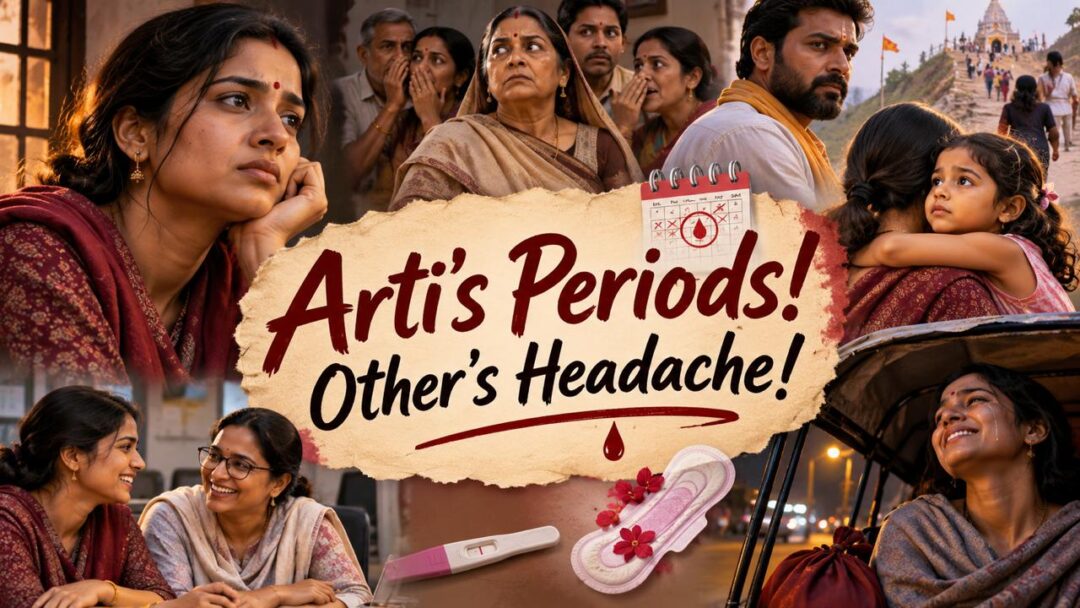
Arti woke up early in the morning and went to the washroom. She checked again, but her heart sank.
She missed her periods…
She felt a sudden wave of worry. She usually got it right on time, so the delay left her feeling stressed and wondering what might be going on.
Her only child, Nitu, is just four years old and is about to go on a pilgrimage with her father. Arti gently pleaded with her husband not to take Nitu this time, explaining that she is still too young to understand and that she loves being with her mother, rarely spending even a day apart from her. This was another reason Arti felt stressed.
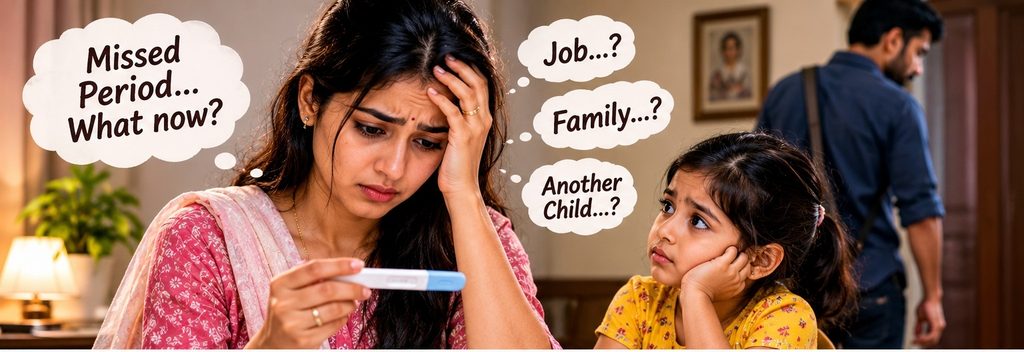
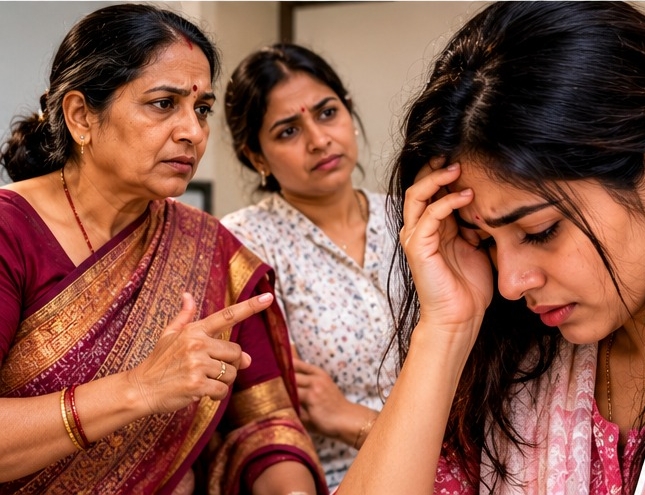
The news quickly spread through her family, and everyone started wondering why Arti had not had her period and why it was late!
Hearing all these comments made her feel even more uncomfortable. She did not want another child. She had been suffering for the past seven years and felt as though she had been through hell. She fell in love with Ram when she was 19. Two years after they got married, she had Nitu, who soon became her whole world. After the birth, Ram did not take good care of her. Sometimes he came home, and sometimes he did not.
Arti recently joined a small venture and is happy to be working there. She knows that becoming pregnant could put her job at risk, and right now, this is her only source of livelihood. She is free to do her work as she chooses and is committed to showing up regularly. Still, she feels concerned because there are no other job opportunities in her small village.
Now that her period is more than five days late, people have started asking her, “Ab tak nahi?” It is frustrating. How has her period become such big news? She usually does not even keep track of the date herself, but whenever it is late, everyone seems to know. Each morning, her mother in law asks, “Ab tak nahi?” In fact, she does not say a word. She simply raises her eyebrows and then glances curiously at Arti’s stomach. This daily routine makes Arti feel extremely uncomfortable. When Arti does not respond, she simply closes her eyes and turns away, letting her reaction speak for itself.
When Ram begins his “vruth,” she is not allowed to enter his room or even touch him. He will not eat the food she prepares, so her mother in law makes his meals instead. She has to get up at four o’clock every morning to clean the house. She never calls it her home. When asked why, she always refers to it as “his home.” She replies, “I never felt like it.”
Arti’s mother in law is worried about her period because, once Arti gets it, she can be forced out of the house for seven days. Since Arti is not allowed to stay there, even briefly, her mother in law is pleased to have the house to herself for a while. Arti is also kept from seeing her own daughter and cannot even call Nitu because the family believes that “God does not want menstruating women to speak with His devotees.” They fear He may punish them or send them to hell after death.
Arti sometimes jokes, “For them, hell is awaiting them only after death, but for me, God has put me in hell while I am still living.” What sort of God! I do not understand.
Why is Ram waiting for her period? Is he hoping it will humble her? He seems to feel that her confidence has grown since she started earning her own money, and that this will give him a chance to feel victorious over her. That may be why he is waiting for her period.
For Nitu, this is a difficult time. She will miss her mother over the coming week and may wonder who she can share her after school stories with.
Her maternal family is also waiting for her period to resume. One concern is that Ram’s mother may blame them for disrupting her son’s pilgrimage, even though he is solely responsible for the incident. Her family is also worried because they will need to care for her during her pregnancy, and she will move to her husband’s home only after giving birth.
Interestingly, Arti was waiting for her period to arrive so she could spend seven days away from Ram’s house and enjoy some peace at her workplace. She had already received permission from her superior to stay there. After work, she hoped to get a good night’s sleep. That was what she was looking forward to.
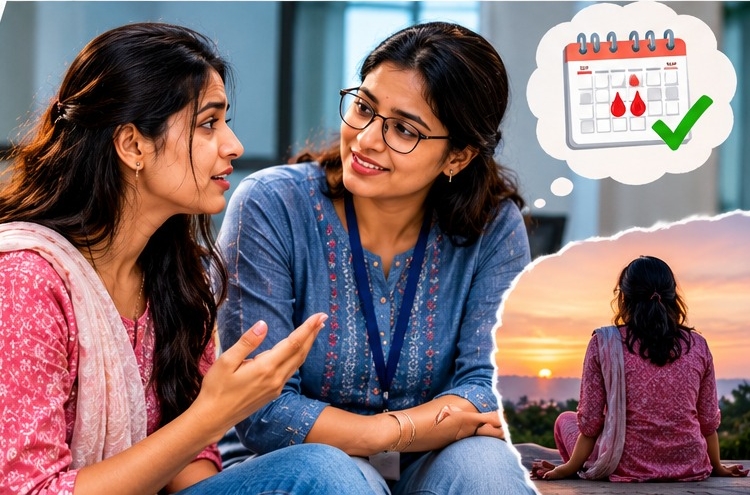
She had a strong rapport with Rashmi ma’am and felt comfortable talking to her. When she shared her feelings about her period, she expressed her frustration and had an open conversation with Rashmi ma’am.
“I am really frustrated by this. Why is it a problem for humans but not for other animals?” she asked, sharing her concerns.
Rashmi hesitated at first, then replied, “Of course, everyone goes through this. But humans are civilised, so periods are sometimes treated as a crime for us. Even after marriage, if you have regular periods, society worries about you. Why are you still on time? And just imagine, if you are unmarried and your periods are delayed, it is considered a crime. If you are married and you have not had a period for three months, it is considered good news. Our society has a different approach to periods, and for us, it is not just about periods. It is about politics, too. There are many things behind this simple red line.”
Rashmi continued, “At least you can speak openly about this now. In the past, people were not allowed to talk about it openly, and girls had to stay in a separate house for seven days. It is called a ‘period home’ because you are not allowed to see anyone or talk to anyone for seven days. You will need to stay in this house for a week.”
Arti interrupted, “If we still had such a system today, I could actually be happy.”
Rashmi asked her why.
She said, “So that I could have considered it as God punishing Ram and his mother every seven days in a month.” Then she laughed.
She continued, “You know, ma’am, the medical shopkeeper still gives me a strange look when I ask for a pad, as if I have stolen something from him. And even though I am in pain and suffering, Ram will not go and buy one because he feels ashamed. But he does not mind coming to me at night.”
Rashmi was stunned for a while and kept gulping.
Then Rashmi continued, “So, do you understand why it is immaterial for animals but a humongous subject for humans? Animals are happy living their natural lives, and we do not even bother about whether they have periods or not. Even our gods are bothered by your red line. If God saw you then, He would be unhappy. But the same process is what gives birth to a new child. At that time, even God will smile. Only you will cry.”
Then Rashmi laughed.
Arti murmured, “Ladies who do not get their periods or have reached menopause must be happy, ma’am?”
“Who says they are happy with that? They go through so much in their lives. In some societies, they may be blamed for being useless, while in others, they may struggle with hormonal problems. Even their families may not understand what they are going through.”
“Anyway, I am heading out now and can bring you a pregnancy test kit.”
“But, ma’am, I have already asked Ram to bring one, too.”
Rashmi then gave Arti a mischievous smile, and Arti smiled back. It was the kind of exchange only a girl could understand.
That evening, Arti got a negative result on the testing kit and said, “Thank God!”
Rashmi smiled again.
The other night, at midnight, Rashmi received a call. As she answered, she heard the sound of a rickshaw horn. Arti had got her period and had been driven away from her family home in a rickshaw.
She was broken and crying her heart out to Rashmi, as she was not even allowed to see her Nitu. But even through her tears, Arti was smiling.